What to Expect on a Luxury Cruise: Amenities and Onboard Life
Butler service, all-inclusive fine dining, and the details that separate a luxury sailing from a mainstream cruise
Butler service, all-inclusive fine dining, and the details that separate a luxury sailing from a mainstream cruise
Clients often ask us what actually justifies the price gap between a mainstream cruise and a true luxury line — lines like Regent Seven Seas, Silversea, Seabourn, or the suite-only categories on Celebrity and Cunard. The honest answer is that it is not one dramatic feature, but dozens of quiet, compounding details that add up to a fundamentally different way of experiencing a week at sea. Having sailed both extensively, we can tell you exactly what changes once you cross that threshold — and where the money genuinely goes.
All-Inclusive Really Means All-Inclusive
On a mainstream cruise, "all-inclusive" typically covers your cabin, basic dining, and entertainment — while specialty restaurants, premium beverages, gratuities, shore excursions, and Wi-Fi are billed separately and can easily add $75–150 per person per day. On most true luxury lines, the fare genuinely includes unlimited premium beverages including top-shelf spirits and champagne, gratuities built into the fare with no envelope or auto-charge at the end, complimentary specialty dining across every venue rather than a per-visit cover charge, and increasingly, shore excursions and even business-class airfare credits on select itineraries. The upfront fare is higher, but for travelers who like knowing their final bill before they board, luxury lines are often more predictable — and sometimes even cheaper in total spend — than a mainstream cruise loaded with add-ons.
Butler Service and the Suite-Only Ship
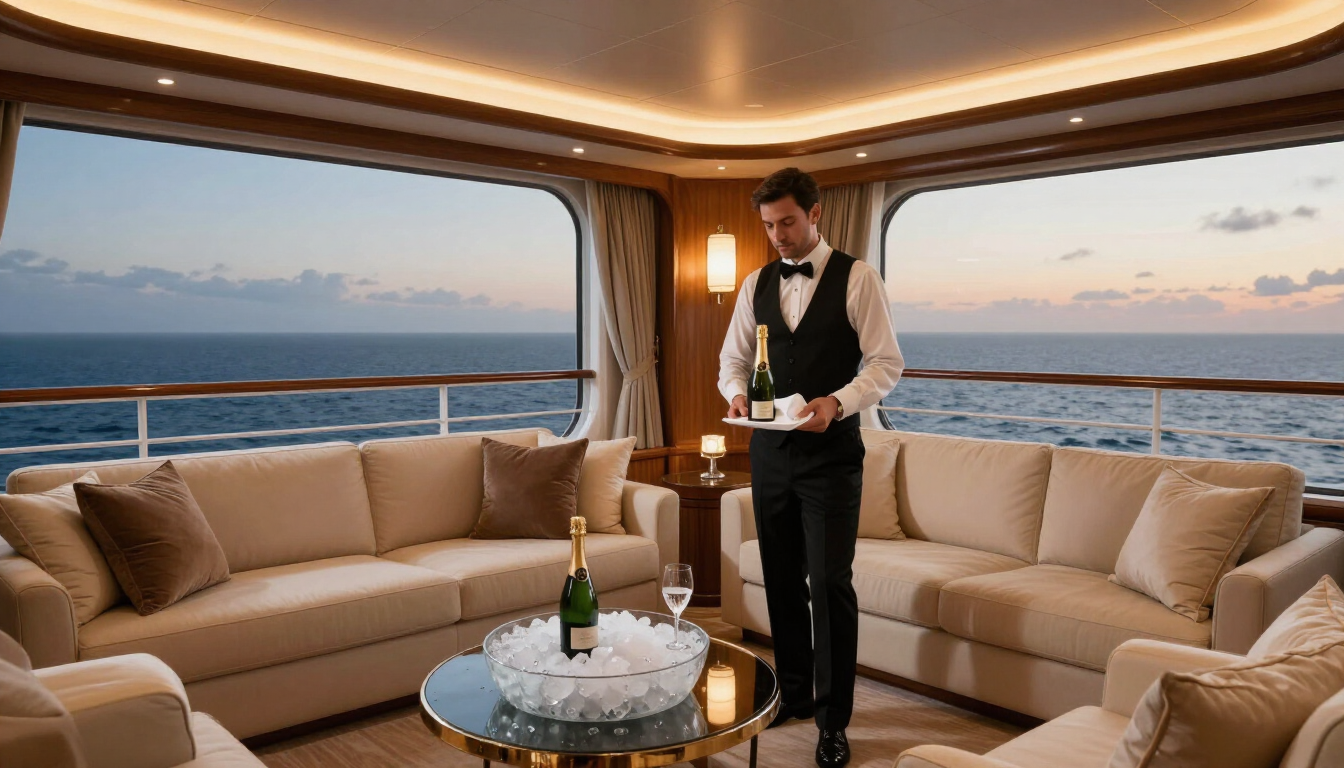
Perhaps the most tangible difference is butler service, standard on suite categories across Regent, Silversea, Seabourn, and the top suite tiers of Celebrity, Cunard, and NCL's The Haven. A butler unpacks and packs your luggage, arranges in-suite dining from any restaurant on the ship at any hour, coordinates your daily schedule, draws a bath, presses your formal wear, and generally anticipates needs before you've voiced them. On fully suite-only ships — Regent's entire fleet, for example — every guest onboard receives this level of service, which changes the entire social atmosphere of the ship; there is no two-tier system of "suite guests" and "everyone else."
Space, Passenger Count, and the Absence of Crowds
Luxury ships carry dramatically fewer passengers relative to their size than mainstream vessels — often 400 to 750 guests compared to 3,000 to 6,000 on a mega-ship. The practical result is no lines at the buffet, no scrambling for a pool chair, and a passenger-to-crew ratio that frequently approaches nearly one crew member per guest. Public spaces feel like a boutique hotel rather than a small city, and specialty restaurants rarely require a reservation booked months in advance the way they do on a mainstream ship. If you're coming from a mega-ship background and wondering whether the trade-off of fewer onboard activities is worth the extra calm, our guide to <a href="/blog/how-to-choose-the-right-cruise-line" class="text-gold hover:text-gold/80 underline underline-offset-2 transition-colors">choosing the right cruise line</a> walks through exactly which traveler profile suits which ship size.
Dining as a Genuine Culinary Experience
On a luxury sailing, dining moves from "included buffet plus a few paid specialty restaurants" to a rotation of genuinely excellent, chef-driven venues — often four to eight distinct restaurants, all included, each with a different cuisine and atmosphere, and each capable of holding its own against a respected restaurant on land. Wine pairings from a curated list, tableside preparation, and flexible timing (dine at 6:00 or 10:00, alone or with new friends, in the main dining room or in your suite) are standard rather than a premium upcharge.
Spa, Wellness, and Enrichment Programming
Luxury lines typically build far more robust wellness and enrichment programming into the standard fare: full-service spas with thermal suites, guest lecturers (historians, naturalists, former diplomats, celebrated chefs) depending on the itinerary, and small-group fitness classes rather than a crowded gym. Expedition-style luxury lines sailing to Antarctica, the Galápagos, or Norway's fjords also typically include Zodiac excursions, naturalist guides, and expedition equipment as part of the fare — no separate excursion desk required.
Who a Luxury Cruise Is Actually Right For
Luxury cruising tends to suit travelers who have already done a few mainstream cruises and know they want a calmer, more curated pace; couples celebrating a significant anniversary or honeymoon who want an elevated version of a special trip (see our <a href="/travel/honeymoon-travel" class="text-gold hover:text-gold/80 underline underline-offset-2 transition-colors">honeymoon travel planning guide</a> for specific ship recommendations); and travelers who value predictable, all-in pricing over the flexibility of paying only for what they use. It is generally not the best fit for families chasing waterslides and youth clubs for younger children, or first-time cruisers still deciding whether cruising itself is for them — a mainstream line is usually the better and more affordable starting point.
If you're trying to decide whether the jump to a luxury line makes sense for your next trip, a <a href="/schedule-consultation" class="text-gold hover:text-gold/80 underline underline-offset-2 transition-colors">free Zoom consultation</a> with Trip and Cindy is the easiest way to compare real itineraries and real pricing side by side, with honest advice from people who have sailed both ends of the spectrum many times over.