Cruise vs All-Inclusive Resort: Which Is Right for You?
An honest side-by-side comparison of the two most popular vacation formats — value, experience, flexibility, and which one fits your travel style
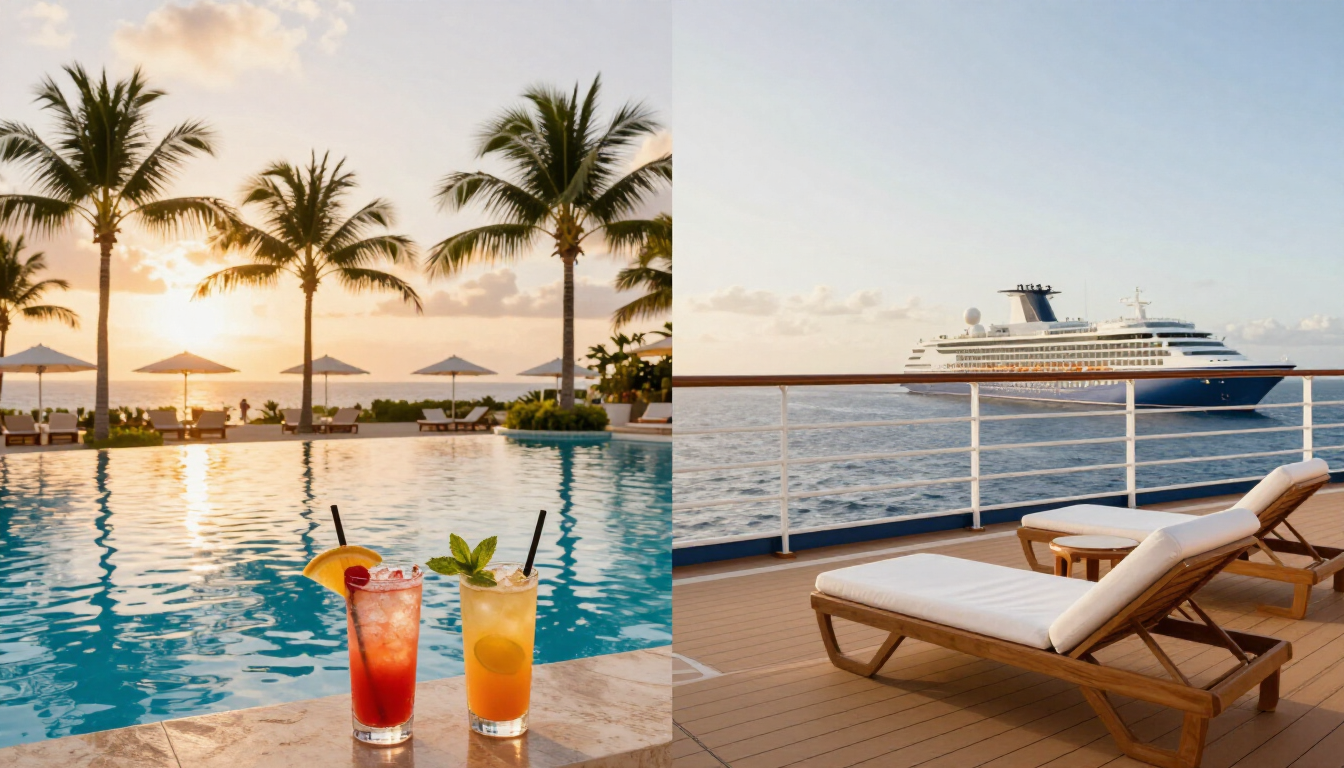
An honest side-by-side comparison of the two most popular vacation formats — value, experience, flexibility, and which one fits your travel style
This is the most common question we answer at Premier Travelers, and it has no universal answer — which is itself an important piece of information. Both a cruise and a well-chosen all-inclusive resort can be extraordinary vacations. The question is which one is extraordinary for you, on this trip, with your specific travel party, budget, and goals. What follows is the most comprehensive honest comparison we can provide, drawn from booking and personally experiencing both vacation formats across decades of travel. We'll compare them on eight dimensions that matter to real travelers: value, food, flexibility, destinations, families, couples, activity, and logistics. By the end, you'll have a clear answer for your situation.
Value: How Do They Actually Compare?
The value comparison between cruises and all-inclusive resorts is more nuanced than most travelers expect, because both products use "all-inclusive" as a marketing umbrella that covers very different things depending on the specific brand and property.
A mainstream Caribbean cruise (Carnival, Royal Caribbean, Norwegian) advertised at $699 per person for 7 nights is not fully inclusive. Add port fees and taxes ($150 per person), automatic gratuities ($16–$18 per person per day, or roughly $120 per person per week), a beverage package if you drink ($70–$90 per person per day), and two specialty dinners ($40–$60 per person per restaurant), and your $699 base fare becomes $1,200–$1,500 all-in. That's still excellent value, but it's not the $699 number. At a premium all-inclusive like Excellence Playa Mujeres or Sandals Royal Barbados, a 7-night stay at comparable quality runs $3,000–$5,000 per couple with alcohol, dining, and activities genuinely included — a higher headline number, but a more predictable total cost.
The value equation flips at higher price points. A luxury cruise on Silversea or Regent — truly all-inclusive with shore excursions, premium beverages, specialty dining, flights, and gratuities bundled — delivers a per-day value that often rivals or exceeds comparably positioned all-inclusive properties when every included element is costed separately. Our guide to <a href="/blog/luxury-cruise-lines-what-sets-them-apart" class="text-gold hover:text-gold/80 underline underline-offset-2 transition-colors">luxury cruise lines and what sets them apart</a> runs through this math in detail.
Food and Dining: An Honest Assessment
This is where the cruise wins decisively at every price tier, and it's not particularly close. Even mainstream cruise ships offer 10–15 dining venues ranging from casual buffet and poolside grills to specialty steakhouses, Asian fusion restaurants, and Italian trattorias. The diversity of options on a 7-night cruise — between 70 and 100 meal experiences across dining venues — is simply impossible to match at a resort property, which typically offers 3–7 restaurants serving a fixed menu rotation.
The exception: the highest-end all-inclusive brands (Aman, Six Senses, and select Belmond properties that operate on inclusive models) have culinary programs that rival or exceed premium cruise dining. But these properties operate at price points of $1,500–$3,000 per person per night — well above even luxury cruise territory. In the $200–$500 per person per night range that most all-inclusive travelers occupy, cruise dining wins comprehensively. If you're drawn to all-inclusive resorts primarily because of tropical setting and beautiful food, also consider that <a href="/travel/all-inclusive-resorts" class="text-gold hover:text-gold/80 underline underline-offset-2 transition-colors">the right all-inclusive resort</a> in Mexico or the Caribbean can deliver genuinely extraordinary dining at much better value than a mid-tier hotel product.
Flexibility: Who Wins and When It Matters
All-inclusive resorts win on flexibility, and the margin is significant. A resort stays put — you unpack once, your room is always accessible, you can return to the beach after a nap without planning, and there is no fixed departure time or tender schedule governing your day. If you want to sleep until 10 am, eat lunch at the pool bar, and spend the afternoon reading on the beach, nothing and nobody will interrupt that plan.
A cruise operates on a schedule. Ports have departure times, tender queues happen, meals in the main dining room have reservation windows, and certain onboard activities require sign-up. First-time cruisers sometimes find this structure more constraining than they expected. Experienced cruisers generally appreciate it — the schedule provides a satisfying rhythm and ensures you see multiple destinations rather than spending an entire week on one beach. The right choice depends on how you experience vacation: are you energized by variety and novelty, or do you recharge through deep relaxation in one beautiful place?
Destinations: The Cruise's Decisive Advantage
A 7-night Caribbean cruise visits 4–5 destinations. A 7-night all-inclusive stay visits one. For travelers who are motivated by seeing new places, by collecting experiences, and by the particular excitement of waking up in a different port each morning — this difference is fundamental. The cruise format was literally designed for this: efficient multi-destination travel in a single booking with no added logistics.
The comparison becomes even more stark for destinations outside the Caribbean. A 10-night Mediterranean cruise visiting Athens, Santorini, Dubrovnik, Rome, and Barcelona is a travel experience that would require a complex, expensive multi-city hotel itinerary to replicate independently — and at a significantly higher total cost. No all-inclusive format can deliver the equivalent of a Mediterranean cruise's destination breadth. Our detailed <a href="/blog/mediterranean-cruise-ports-guide" class="text-gold hover:text-gold/80 underline underline-offset-2 transition-colors">Mediterranean cruise ports guide</a> shows exactly what's possible in a single sailing.
Traveling with Children: Which Format Wins?
Both formats can be excellent for families, but they excel in different ways and the winner depends on your children's ages and temperaments.
Younger children (under 8) often do better at all-inclusive resorts because the environment is more contained, the schedule is entirely self-directed, and the beach and pool are always accessible without planning. There are no tender queues, no port logistics, and no departure times to manage. The all-inclusive beach resort model at properties like Excellence, Secrets (adults-only), or Barcelo was not designed for toddlers — but Beaches, Club Med, and select Karisma properties are brilliantly engineered for families with young children.
Older children and teenagers, however, almost universally prefer the cruise. The onboard programming — waterslides, surf simulators, rock climbing walls, escape rooms, arcades, youth clubs organized by age, teen-only spaces — is simply not replicable at a land resort. Royal Caribbean's newest ships are particularly compelling for families with tweens and teens, offering activities that compete directly with theme parks. Family cruise planning requires a slightly different approach to ship selection; our <a href="/cruises/family-cruises" class="text-gold hover:text-gold/80 underline underline-offset-2 transition-colors">family cruise planning guide</a> identifies the ships and lines that consistently deliver for multigenerational groups.
For Couples: The Most Context-Dependent Decision
For couples without children, the choice between a cruise and an all-inclusive resort is the most genuinely difficult of all the traveler-type comparisons — because both can be extraordinary, and the right answer depends almost entirely on relationship style and vacation philosophy.
Couples who thrive on shared experiences, discovery, and novelty tend to love cruising — every day brings a new destination, every evening brings a different show or restaurant or sunset. The built-in variety reduces the "what do we do today?" decision fatigue that can accumulate on week-long beach stays. Couples who most need disconnection, deep relaxation, and the freedom of absolutely no schedule tend to prefer the all-inclusive resort model — particularly at adults-only properties where the atmosphere is genuinely refined.
For honeymoon travelers specifically, our <a href="/travel/honeymoon-travel" class="text-gold hover:text-gold/80 underline underline-offset-2 transition-colors">honeymoon travel planning guide</a> addresses this comparison in detail, including the specific cruise lines and resort brands that consistently deliver for newly married couples. The short answer: a luxury cruise scores higher than a mid-range all-inclusive for most honeymooners, and a world-class boutique all-inclusive scores higher than a mainstream cruise. The middle of both ranges is competitive.
Logistics: Which Is Easier to Book and Manage?
All-inclusive resorts win on logistics simplicity. One property, one booking, one transfer from the airport. The entire experience takes place in a defined perimeter. Cruise logistics are more complex: choosing a ship, a homeport, booking airfare that connects correctly to embarkation day, pre-cruise hotel stays to buffer against flight delays, transportation to the cruise terminal, and managing shore excursion schedules across multiple ports.
This complexity is exactly where a knowledgeable travel advisor eliminates the friction. The logistics of a well-planned cruise are genuinely manageable — we handle them for clients every day — but they require more expertise to optimize than booking a direct flight to Cancun. Working with a <a href="/services/cruise-travel-agent-florida" class="text-gold hover:text-gold/80 underline underline-offset-2 transition-colors">Florida cruise travel agent</a> means the embarkation logistics, the port-day planning, the shore excursion booking, and the pre/post-cruise hotel coordination are handled for you, often with available supplier perks when eligible added at no extra cost.
The Verdict: How to Decide
A <a href="/schedule-consultation" class="text-gold hover:text-gold/80 underline underline-offset-2 transition-colors">free 15-minute Zoom consultation with Trip or Cindy</a> is genuinely the most efficient way to make this decision. We'll ask you four or five questions and give you a clear recommendation with specific options — saving you hours of online research that, in our experience, makes the decision more confusing, not less.