Cruise Cabin Types Explained: Interior, Ocean-View, Balcony & Suites
Inside cabins, balconies, suites, location on the ship — everything you actually need to know to pick the right cabin for your cruise
Inside cabins, balconies, suites, location on the ship — everything you actually need to know to pick the right cabin for your cruise
Choose the wrong cabin and you'll spend a week listening to the pool deck above your head, fighting seasickness at the bow, or wishing you'd splurged on a balcony the moment you see the ocean outside someone else's door. Choose the right cabin and it becomes a genuine retreat — somewhere you look forward to returning to each evening. After 80+ personal sailings and years of booking travel for us and family, here's everything Cindy and I have learned about cruise cabin selection done right.
The Four Main Cabin Types: An Honest Assessment
An inside cabin has no window to the outside. In exchange for giving up natural light, you pay the lowest possible fare and often get a cabin that sleeps just as well — or better, thanks to the complete darkness — as any other category. Veteran cruisers who spend most of their time at ports or in public spaces frequently choose inside cabins intentionally. They're also the best option if you're trying to stretch your budget to a longer sailing or a premium cruise line you'd otherwise skip.
Ocean view cabins add a porthole or fixed window, giving you natural light and a sense of connection to the outside without the added cost of a balcony. They're a meaningful upgrade over inside cabins on sea days and in northern destinations like Alaska or Norway, where the scenery outside the window is the point. The key limitation is that the window doesn't open — you can see the ocean but can't feel the sea air.
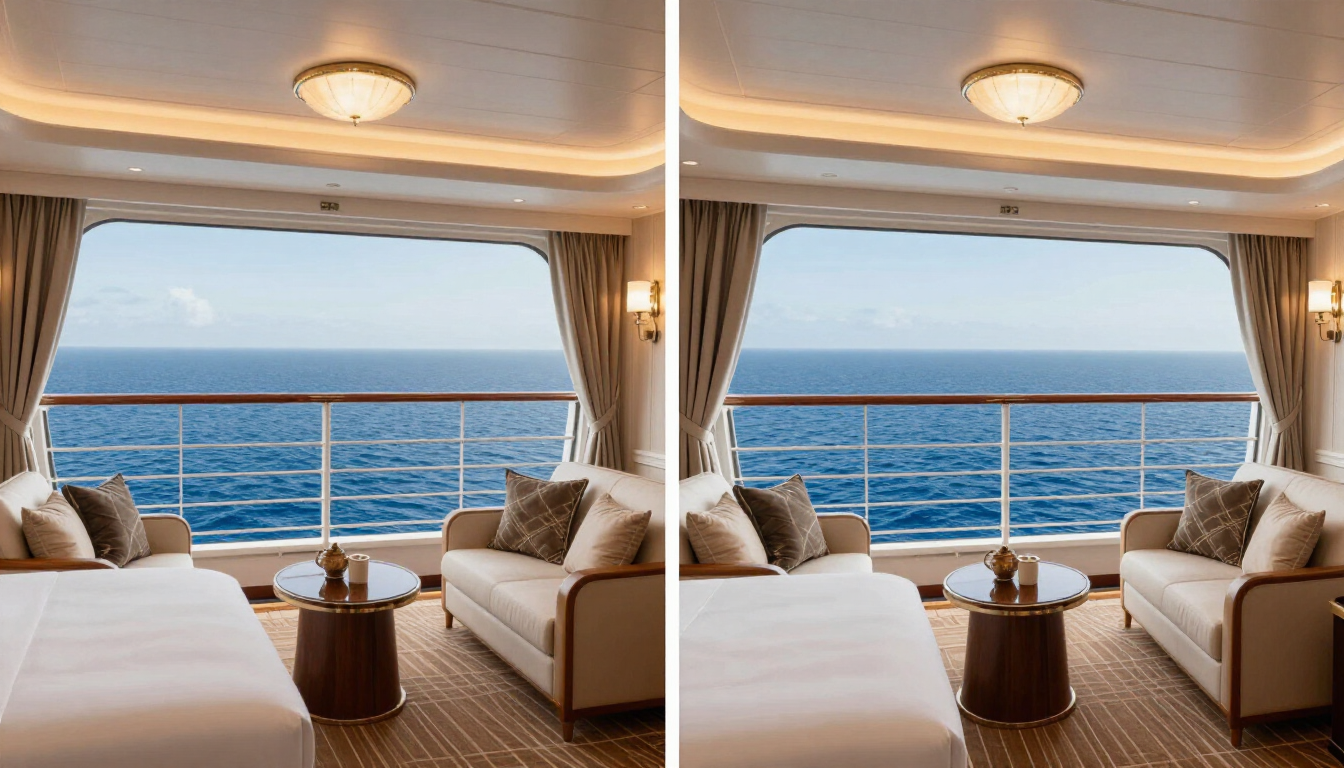
A balcony is the single most impactful cruise upgrade for most travelers. The private outdoor space transforms the experience on sea days — morning coffee watching the ocean, evening cocktails as the sun sets, fresh air at any hour. On itineraries where you're at sea for multiple days (transatlantic, repositioning cruises, Alaska Inside Passage), a balcony can feel less like an upgrade and more like a necessity. Balcony cabins run roughly 25–50% more than comparable inside cabins, and for most travelers we work with, it's the upgrade they never regret.
A suite isn't just a larger cabin — it's a different tier of cruise experience. Priority embarkation and disembarkation, exclusive restaurants and lounges, butler service, better bedding, more storage — the suite package on most lines transforms the logistics of the trip significantly. On lines with a "ship-within-a-ship" concept (Royal Caribbean's Suite Class, MSC's Yacht Club, Norwegian's Haven), suite guests have their own private pool, sundeck, and dining, which effectively means two different vacation experiences happening on the same ship.
Specialty Cabin Types
Aft balcony cabins sit at the very back of the ship, overlooking the wake. They're often the same category as a regular balcony but with a dramatically larger outdoor space — sometimes two or three times the square footage of a standard balcony. The view of the ship's wake stretching to the horizon is uniquely peaceful. The trade-off: some vibration from the propellers and a little more noise. For Alaska or repositioning itineraries, an aft balcony is one of the best deals on the ship.
Forward cabins at the bow offer front-row views of the ship's approach into ports — spectacular in the fjords of Alaska or Norway. They feel the most motion in rough seas, though, and the anchor chain operation can be noisy in the early morning hours. Avoid forward cabins if you're prone to motion sickness.
Families with young children often benefit from connecting cabins — two adjacent staterooms with an interior door between them. Adults get their own space while kids have supervision and access through the shared door. When you book connecting rooms, make sure you're booking both sides — you don't want a stranger's connecting door as your neighbor. Some ships also offer family-specific cabins with built-in bunk space for three to four travelers in a single room.
Solo cruisers have traditionally been charged a "single supplement" of up to 100% of the cabin fare — meaning they pay for two people even though they're traveling alone. Several cruise lines now offer dedicated solo cabins (Norwegian Cruise Line pioneered this with their Studio cabins) that are purpose-built for solo travelers and priced without the supplement. Solo cabin categories are limited and sell out quickly; book early.
Accessible cabins are designed for travelers with mobility limitations and are required to be available on every ship in a US-flagged or US-homeporting fleet. These cabins feature roll-in showers, wider doorways, lower bed heights, and turning radius space for wheelchairs. They're in high demand; book as early as possible if you need one.
Cabin Location on the Ship: Where to Be and What to Avoid
Midship cabins (roughly the middle third of the ship) are the smoothest in rough seas because they're closest to the ship's natural rolling pivot point. They're also the most convenient — usually equidistant from the forward elevators, the aft elevators, the main dining rooms, and the pool. If you can only optimize one thing about your cabin location, choose midship.
Higher decks (closer to the pool and public areas) mean more noise from foot traffic and activities above. Lower decks are quieter and feel less motion, but are also darker and sometimes have obstructed views. The middle decks — typically decks 6 through 10 on most large ships — are the best compromise.
Motion Sickness Considerations
If motion sickness is a concern, cabin selection matters a great deal. Choose midship, on a middle deck (not too high, not too low), and avoid the very front or back of the ship. On itineraries with potentially rough seas — transatlantic crossings, the Drake Passage, the Gulf of Alaska — this is especially important. Medication (scopolamine patches prescribed by your doctor, Bonine, or sea bands) supplements good cabin placement but isn't a substitute for it.
Proximity to Elevators and Amenities
A cabin within 30 seconds of an elevator sounds minor until you're carrying groceries from the pool back to your cabin six times a day. For travelers with mobility limitations or families with small children, close elevator access is genuinely important. The flip side: cabins immediately adjacent to elevator lobbies can be noisy with door traffic.