Balcony vs Interior Cabin: Which Should You Book?
A practical guide to the real differences between cruise cabin categories — when the upgrade is worth it and when you're better off saving the money
A practical guide to the real differences between cruise cabin categories — when the upgrade is worth it and when you're better off saving the money
The balcony cabin upgrade is the single most debated booking decision in cruising. Online forums are full of passionate advocates for both positions: the "always get a balcony" camp argues that private outdoor space transforms the cruise experience, while the "save the money for excursions" camp argues that you spend so little time in your cabin that the upgrade is essentially wasted. After 80+ personal cruises across every cabin category, our honest position is: both camps are partially right, and the correct answer depends on factors that neither side fully accounts for. This guide gives you the complete framework to make the right decision for your specific trip.
What You Actually Get: The Real Differences
An interior cabin has no window. It is, by definition, a dark room — the only light comes from artificial sources, and there is no visual connection to the outside world. Interior cabins on modern ships are typically 150–185 square feet and include a queen or two twin beds, a small bathroom, a desk, and closet storage. They are fully functional, often surprisingly comfortable, and represent the most affordable way to cruise.
An ocean view cabin adds a window — a fixed porthole or larger picture window — but no outdoor access. You can see light and water but cannot open the window or step outside. Ocean view cabins occupy a middle price tier but don't deliver the outdoor experience many travelers associate with "being at sea." For that reason, we typically advise clients to choose between interior and balcony rather than treating ocean view as a midpoint — the price difference between ocean view and balcony is usually less than the difference between interior and ocean view, making the full balcony upgrade often the more rational choice at only a modest additional cost. For a detailed breakdown of the ocean view vs. balcony decision specifically, our guide to <a href="/blog/balcony-vs-ocean-view-cabin" class="text-gold hover:text-gold/80 underline underline-offset-2 transition-colors">balcony vs. ocean view cabins</a> covers every scenario.
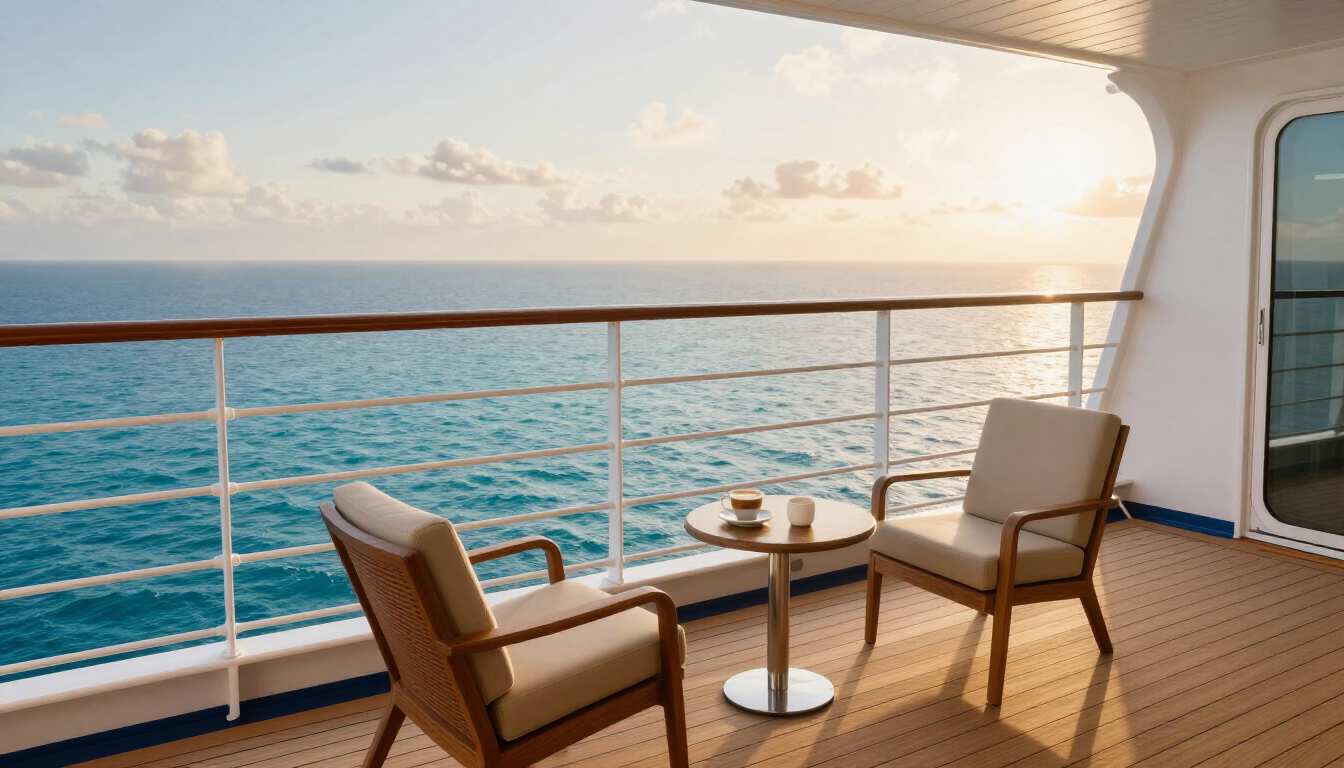
A balcony cabin adds a private outdoor space — typically 40–60 square feet on most mainstream ships, larger on premium lines — with a sliding glass door, two chairs, a small table, and a railing at chest height. You can step outside, feel the sea air, watch sunrises and sunsets, see coastlines approaching, and experience the actual sensation of being at sea in a way that is simply not available from inside the ship.
When a Balcony Is Absolutely Worth It
There are specific itinerary types where booking a balcony cabin is not merely worth it but is strongly advisable — where skipping the balcony means missing a significant portion of what makes the destination special.
Alaska is the clearest example. Unlike Caribbean cruises, where your days are spent in port, an Alaska cruise is a destination where the ship itself is the attraction. Glacier Bay National Park, the Inside Passage, Tracy Arm Fjord — these are experiences that unfold continuously from the ship over many hours. Watching a glacier calve from your private balcony at 6 am with a cup of coffee, seeing humpback whales breach from your own outdoor space without fighting for rail position, or watching the Alaskan coastline slide past from a completely private vantage point are experiences that cannot be replicated from a window or from the public decks. On an Alaska sailing, we recommend a balcony cabin without reservation. Our <a href="/blog/best-time-to-cruise-alaska" class="text-gold hover:text-gold/80 underline underline-offset-2 transition-colors">Alaska cruise guide</a> covers this recommendation in detail.
When an Interior Cabin Makes Sense
The interior cabin argument is strongest on short sailings where you spend the vast majority of your waking hours ashore or on the ship's public decks, and where the price difference between interior and balcony is substantial relative to the overall trip cost.
A 4-night Bahamas sailing out of Jacksonville on the Carnival Elation, for example, has two port days (Nassau and a private island) and two days of transit. If you're an early riser who will be on the pool deck at sunrise anyway, if you plan to spend every possible minute ashore, and if the cost difference between interior and balcony represents $200–$300 per person that you'd rather put toward a shore excursion or specialty dinner — the interior cabin argument is entirely reasonable. The key insight: you'll sleep just as well in an interior cabin (actually better, since they're completely dark), and your "outdoor time" on a Bahamas sailing is primarily ashore and at the pool, not on a private balcony.
The Cost Reality: How Much More Is a Balcony?
Balcony upgrade costs vary significantly by cruise line, ship, sailing date, and how far in advance you book. As a general framework: on mainstream lines (Carnival, Norwegian, Royal Caribbean) for a 7-night Caribbean sailing, balcony cabins typically run $150–$400 per person more than comparable interior cabins — meaning $300–$800 extra per couple for the week. On premium lines (Celebrity, Princess, Holland America), the spread is similar. On luxury lines, virtually all cabins include a balcony or veranda as a baseline.
The timing of your booking also affects this premium. During Wave Season (January–March), cruise lines frequently run promotions that include cabin upgrades — sometimes offering balcony pricing at rates close to interior. A client who books early and monitors fare adjustments through their advisor can sometimes secure a balcony cabin at near-interior pricing when these promotions align. Our guide to <a href="/blog/best-time-to-book-a-cruise" class="text-gold hover:text-gold/80 underline underline-offset-2 transition-colors">the best time to book a cruise</a> covers these promotion windows in detail.
Cabin Location: The Other Decision Within Balcony Booking
Once you've decided on a balcony, cabin location within the ship matters more than most travelers realize. Mid-ship balcony cabins on higher decks are the premium choice: they provide the most stable ride (least motion in rough seas), the best elevation for views, and the most central access to ship amenities. Bow cabins experience more motion and noise. Stern (aft-facing) balcony cabins are a fascinating alternative — they overlook the ship's wake rather than the open sea, provide a truly private view that no other cabin type offers, and are beloved by experienced cruisers who know to seek them out. Aft-facing balconies are limited in number and sell quickly, so booking early is essential if this appeals to you.
Avoid balcony cabins directly below pool decks, as chair-scraping noise above can be disruptive early in the morning. Cabins adjacent to elevators and stairwells trade traffic noise for convenience; whether that tradeoff works depends on how lightly you sleep. If you're unsure about the best cabin location for your specific ship, this is exactly the kind of detail a <a href="/services/jacksonville-cruise-specialist" class="text-gold hover:text-gold/80 underline underline-offset-2 transition-colors">knowledgeable cruise specialist</a> will advise on before you commit to a booking.
Suite Cabins: When to Consider the Jump Beyond Balcony
The conversation about balcony vs. interior sometimes misses the option at the other end of the spectrum: suites. On mainstream ships, suite categories add meaningful living space (a separate sitting area, a larger balcony, a premium bathroom, butler service in some categories), priority boarding, access to private sun decks, and concierge services that genuinely change the experience. For travelers who spend significant time in their cabin — families with young children during nap time, couples who want private dining on the balcony, guests recovering from a physical limitation — the suite experience can justify its premium.
Royal Caribbean's Star Class and Sky Class suites come with a Royal Genie (a private butler-concierge hybrid) and include all specialty dining, beverages, and gratuities — making them functionally all-inclusive within a mainstream cruise booking. Norwegian's The Haven is a private enclave within the ship with its own restaurant, sundeck, pool, and concierge team. Celebrity's Retreat delivers a similar exclusive-access experience. If your budget allows, the suite tier on a mainstream ship is competitive with a standard cabin on a luxury ship for total-experience value.
The Bottom Line
Our honest recommendation, drawn from 80+ personal cruises and years of experience booking travel for us and family: book a balcony cabin unless you have a specific, well-reasoned case for the interior — a very short sailing with port-dominant days and a meaningful cost difference that will be redirected to experiences. For most 7-night sailings, particularly to Alaska, Norway, or the Mediterranean, the balcony premium is the single best value upgrade in cruising. For a 4-night Bahamas sailing on a budget, saving the $200–$300 per person and spending it on a glass-bottom boat tour is a reasonable trade.
Not sure which cabin is right for your itinerary? A <a href="/schedule-consultation" class="text-gold hover:text-gold/80 underline underline-offset-2 transition-colors">free consultation with Trip or Cindy</a> takes 15 minutes and will give you a specific recommendation for your ship, sailing date, and travel style. Cabin selection is one of the areas where advisor knowledge makes the most tangible difference.